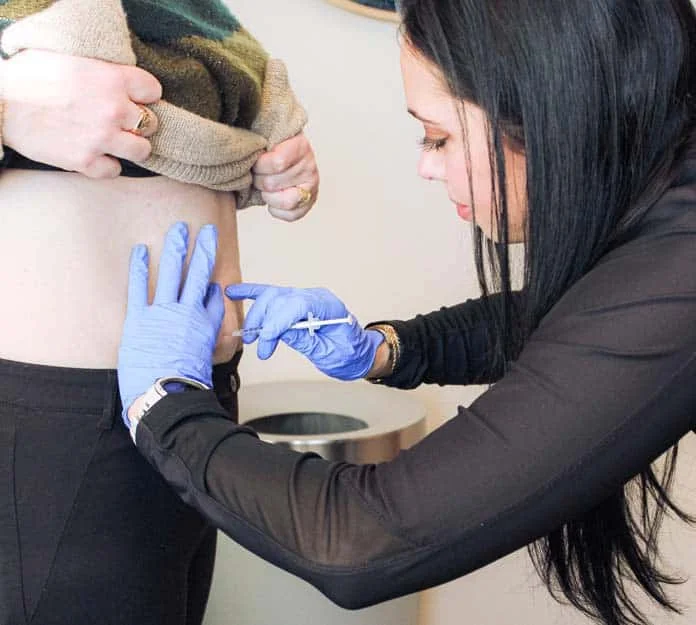

The correct Ozempic dosage for weight loss is not a single number you land on and stay. It is a deliberate ladder that starts low on purpose, climbs every four weeks, and stops wherever your body says stop. Most of the dosing charts online reprint the drug label and leave it there. This is how a doctor-supervised clinic actually runs the titration, and why the day-one dose is deliberately too weak to do much.
The Ozempic dosage schedule (the standard titration ladder)
Ozempic is the brand name for semaglutide, a once-weekly injection you give yourself at home. One point worth being precise about up front: Ozempic is FDA-approved to treat type 2 diabetes, and doctors have prescribed it off-label for weight management for years. The version of semaglutide that carries a specific FDA weight-loss indication is branded Wegovy. Same molecule, different label and a slightly higher ceiling. We will come back to that ceiling in a moment.

Here is the standard label schedule, the ladder nearly every patient climbs. Read the timing as a floor, not a promise: nobody is required to move up on week five just because the calendar says so.
That schedule is the label default. It is also individualized by your provider, which is the whole point of running this through a clinic rather than a mail-order refill. Some patients spend eight weeks at 0.5 mg because that dose alone is doing the job. Others hold at 1.0 mg for months. A schedule on paper is a starting assumption; your actual ladder is written week by week based on how you respond.
What is the max dose of Ozempic for weight loss?
The maximum Ozempic dose on the FDA label is 2.0 mg once weekly. That is the top rung of the ladder above, and it is the correct answer to "what is the max dose of Ozempic for weight loss" as long as you are talking about Ozempic specifically.
Ozempic tops out at 2.0 mg. Wegovy, the semaglutide product FDA-approved for weight loss, tops out at 2.4 mg. So when a chart says the max semaglutide dose is 2.4 mg, it is describing Wegovy, not Ozempic. It is the same drug, just a different label and a slightly higher ceiling. What matters clinically is not hitting a maximum number, it is finding the lowest dose that keeps your weight moving with side effects you can live with.
Here is the part the label charts never say out loud: most patients do not need the max. The max dose exists for people who plateau at lower doses and tolerate the medication well. Pushing every patient to 2.0 mg is not a goal, it is a misunderstanding of how titration works. If you are losing weight steadily at 1.0 mg with a quiet appetite and no rough side effects, that is a good dose, arguably a better dose than 2.0 mg would be for you.
Why the escalation is gradual (and not optional)
The four-week steps are not bureaucratic caution. Semaglutide slows gastric emptying, and your digestive system needs time to adapt to each new dose. Jump the ladder and you buy yourself nausea, and sometimes vomiting, that could have been avoided entirely. Climb it patiently and most patients get away with mild, temporary queasiness that fades within the first week or two at each new dose.
The starter dose is supposed to underperform. Its only job is tolerance, not weight loss. Rushing past it is the single most common self-inflicted mistake we see.
This is exactly where doctor supervision earns its keep. When side effects flare during a dose increase, the right move is often to slow down, hold the current dose an extra few weeks, or step back down, not to white-knuckle through it. We cover the full playbook in our guide to managing semaglutide side effects, but the short version is that the titration schedule should bend to your body, not the other way around.
When to increase your Ozempic dose
The trigger for stepping up is not the calendar alone. Three conditions should line up before you climb to the next rung:
- You have been on the current dose at least four weeks. Anything shorter and your gut has not finished adapting.
- Side effects have settled. If you are still fighting nausea from the last increase, increasing again pours fuel on the fire.
- Weight loss has stalled at the current dose. If the scale is still moving and appetite is still quiet, there is no reason to increase. A working dose is a working dose.
That third point is the one patients get wrong most often. A stall is a reason to step up. Steady progress is a reason to stay put. Chasing the next dose while the current one is still working is how you trade a comfortable, effective regimen for a rougher one that does not lose weight any faster. Our physicians make this call with you at weekly check-ins, which is how GLP-1 therapy gets dosed when a real clinic is watching rather than an app.
How Regner Health Solutions personalizes the ladder
Regner Health Solutions is a physician-led weight loss clinic in Bloomington, MN, serving Minneapolis, Edina, and the surrounding Twin Cities. Our clinical lead, Dave Regner, and the medical team review your health history and starting weight, set your starting dose, and then adjust every step based on weekly check-ins rather than a fixed template.
Online-only services tend to prescribe a dose and disappear until the next refill. We watch the titration in real time. If 0.5 mg is already doing the job, you stay there. If side effects spike, we slow down. If you plateau, we step up on purpose. The schedule is a framework; your response writes the actual plan.
That is the difference between the label schedule and a real titration practice. The ladder in this article is where everyone starts. Where you land, how fast you climb, and whether you ever reach 2.0 mg are decisions made from your data, not a chart. Patients like Melissa, who started semaglutide with us in late 2024, reached their goal weight on a plan tuned to them rather than a maximum dose applied to everyone.
Frequently asked questions
How long does it take to lose 30 pounds on Ozempic?
For many patients, roughly four to eight months, though the honest answer is that it varies widely and nobody can promise a timeline. Semaglutide weight loss builds as you climb the dose ladder, so the first month at the 0.25 mg starter dose usually shows little movement by design. Steady losers often average one to two pounds per week once they reach a therapeutic dose, which puts 30 pounds in the four-to-eight-month range. Your starting weight, dose response, diet, and activity all shift that estimate. We track it weekly rather than guess.
When should I increase my Ozempic dose?
Increase only when three things are true at once: you have completed at least four weeks at the current dose, any side effects from the last increase have settled, and your weight loss has stalled. If the scale is still moving and your appetite is still quiet, stay where you are. A dose that is working does not need to be increased just because a higher one exists. At our clinic, that decision is made with a physician at your weekly check-in.
What is the maximum dose of Ozempic for weight loss?
2.0 mg once weekly is the maximum on the Ozempic FDA label. The weight-loss-labeled version of semaglutide, Wegovy, goes up to 2.4 mg. Most patients do not need the maximum of either. The right dose is the lowest one that keeps your weight moving with tolerable side effects.
Is Ozempic FDA-approved for weight loss?
Ozempic is FDA-approved to treat type 2 diabetes, and doctors prescribe it off-label for weight management. The semaglutide product with a specific FDA weight-loss indication is Wegovy. During a consultation we walk through which option and which dose fit your situation.
Want your Ozempic dosage set by a real clinic, not a chart? Book a free 15-minute consultation with our Bloomington medical team. We will review your history, set a starting dose, and tune the titration to how your body actually responds. Prefer to talk first? Call (612) 895-7721.